When the Data Leader Owns a Number: Reading the Revenue Signal in the DCOI 2026 Speaker Roster

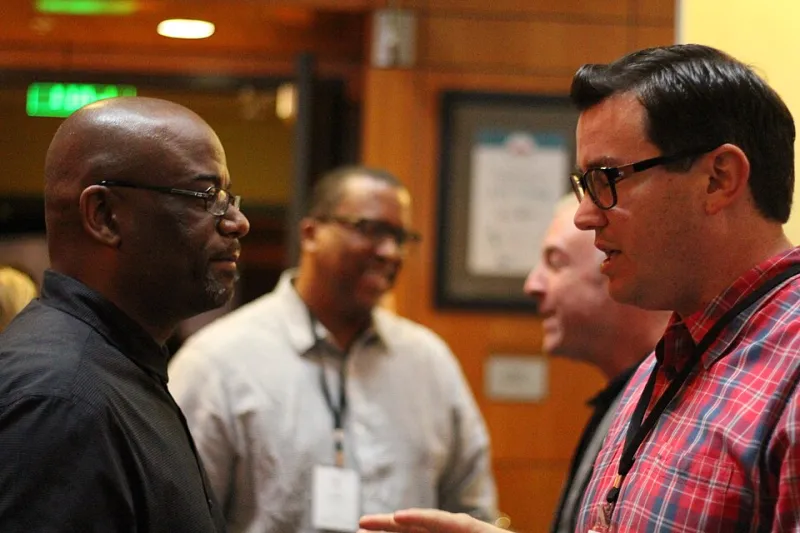
Photo: Creator:NahidHossain This work was made by Nahid Hossain and released under the license(s) stated below. Please feel free to use it for any purpose as long as you credit Nahid Hossain as author and follow the terms of the chosen license. If
Conference programs are rarely written as strategy documents, but they tend to function as one. Read enough session titles in sequence and you can see where an industry believes its next round of value will come from — and, just as tellingly, what it has stopped worrying about.
By that measure, the DCOI 2026 speaker slate was unusually candid. Sessions framed around pricing elasticity, customer lifetime value, pipeline attribution, and revenue operations outnumbered those devoted to platform migration and warehouse consolidation across the three-day program. Governance and security did not disappear, but they appeared most often as constraints on commercial work rather than as ends in themselves.
That is a meaningful repositioning for a discipline that spent much of the past decade arguing for its own existence. The question worth asking now is not whether data teams can be measured on revenue. It is whether they are being handed the authority that such a measurement implies.
The Sessions That Set the Tone
Three clusters dominated the published agenda.
The first treated pricing as a data product. Rather than presenting pricing as a finance function with analytics support, several sessions described pricing models maintained by data teams, with versioning, testing, and monitoring practices borrowed directly from software delivery. A director of analytics at a national restaurant chain described rebuilding a menu pricing model as an internal product with named consumers and a published change log — an approach, she noted, that made her team accountable for outcomes rather than dashboards.
The second cluster concerned customer data as a commercial asset. The recurring argument here was that identity resolution and consent management, long framed as compliance obligations, have become the difference between a functioning retention program and an expensive guess. A chief data officer at a mid-Atlantic insurer put it plainly: the organization stopped funding customer data work when it was described as hygiene, and started funding it when it was described in terms of renewal rates.
The third cluster was organizational, and it drew the most crowded rooms. Sessions on revenue operations and go-to-market analytics wrestled with a structural question: when sales operations, marketing operations, and analytics engineering all touch the same funnel, who owns the number? Speakers did not converge on a single answer, but they were consistent in rejecting the premise that the data team should simply serve whichever function shouts first.
The Boundary Problem Nobody Solved
If there was an unresolved tension in the program, it was the boundary between influence and accountability. A vice president of revenue operations at a B2B software company described a familiar arrangement: the data team builds the forecast model, the sales organization owns the number, and nobody is responsible when the two diverge.
Her proposed remedy was unglamorous. Publish the assumptions. Make the model's inputs legible to the people who will be held to its outputs, and put a standing review on the calendar where those inputs get challenged before the quarter closes. Several later speakers referenced the same session, which suggests the problem is widely shared and rarely addressed head-on.
A second theme worth carrying home concerns hiring. Two sessions touched on the difficulty of recruiting analysts who can hold a conversation with a pricing committee. The consensus was that the skill is trainable but rarely taught, and that organizations which treat commercial fluency as a nice-to-have tend to discover its absence during a downturn.
A Checklist for Making the Case After the Event
Attendees returning to their organizations often find that enthusiasm does not survive contact with a planning cycle. The following sequence is deliberately modest, and is designed to produce a decision rather than a conversation.
- Quantify a decision you already influence. Pick one commercial outcome — a discounting threshold, a churn segment, a lead-scoring cutoff — where your team's work already changes behavior. Establish the current baseline before proposing anything new.
- Identify the P&L owner, not just the tool owner. Alignment fails most often because the data team partners with whoever administers the system rather than whoever answers for the result.
- Bring one artifact, not a summary. A model card, a segment definition, a pricing test design. Concrete outputs travel better across departmental boundaries than conference takeaways.
- Map the revenue meeting calendar. Know where the number is actually set. A proposal that arrives after the forecast is locked will wait a quarter.
- Propose a 90-day engagement with one named metric. Narrow scope is the price of entry; expansion follows evidence.
- Pre-empt the governance objection. Have a position on consent, retention, and access before the first review. Being asked and having no answer is worse than not raising the topic.
- Ask for a seat, not a reorganization. Standing invitations to commercial reviews are cheaper to approve and harder to revoke than structural change.
- Set a review date in writing. Alignment work that has no scheduled checkpoint quietly becomes a quarterly report nobody reads.
Why the Timing Matters
For most US enterprises, late November is when next year's commitments take shape. Budgets are being closed, headcount plans are circulating, and the arguments that will be settled in January are already being drafted. That makes the weeks immediately following DCOI 2026 unusually valuable. A proposal framed now can enter the planning cycle as an option; the same proposal in February arrives as a request for an exception.
The roster made a persuasive case that data teams are becoming revenue teams. The harder work — assigning the number, naming the owner, and living with the variance — happens away from the stage, in rooms where the program is written by whoever shows up with a baseline.